< Back to News and Press Page
Leeds, UK – September 2026
“Mental health cannot remain a whisper.”
That was one of the messages framing Afrikindness’ recent Mental Health Research Dissemination Event, bringing together community members, mental health professionals, researchers, voluntary-sector organisations and other stakeholders to hear the outcomes of Breaking Barriers: Understanding Access to Mental Health Support in Black Communities in Leeds.
The research, undertaken by Afrikindness in partnership with Leeds Mental Wellbeing Service (LMWS) and Touchstone, explored an important question:
What might be preventing Black communities in Leeds from accessing mental health support?
Rather than beginning with assumptions about what communities needed, the project began by listening.
Through community engagement, surveys and focus-group conversations, Black African and Caribbean participants shared their experiences, perceptions and understanding of mental health, as well as their experiences of seeking, accessing and engaging with support.
What did communities tell us?
The research identified a number of interconnected issues shaping people’s experiences of mental health and help-seeking.
Among the areas highlighted were:
- Mental health stigma and the difficulty of talking openly about mental wellbeing within some families and communities.
- Cultural beliefs and perceptions that can influence how mental health challenges are understood and responded to.
- Generational differences in mental health awareness and attitudes towards seeking help.
- Trust, confidence and cultural understanding when engaging with mental health services.
Awareness and accessibility of services, including knowing what support exists, where to go and how to access it.
Importantly, these issues do not exist independently. Culture, stigma, trust, awareness and previous experiences can interact and reinforce one another, creating very different pathways to support for different individuals and families.
The full research report provides the detailed findings, community perspectives and recommendations arising from the study.
From evidence to action
The dissemination event was not simply about presenting statistics.
Participants were invited to reflect on a much bigger question:
“We have heard what communities are telling us. What do we do differently because we have heard it?”
The conversation reinforced the importance of continuing to create opportunities where communities are not simply consulted at the end of service development, but are involved in co-production, design, engagement and evaluation from the beginning.
For Afrikindness, dissemination is therefore not the end of the research.
It is the beginning of the next stage: turning community voice into practical action.
Building on the research
The findings are already helping to inform Afrikindness’ expanding community mental health work.
BLACK MEN’S CONNECT CIRCLE – MEN ONLY
With support from Leeds Community Foundation, Afrikindness is delivering a community-led mental health programme with a particular focus on Black men and families, including community mental health awareness sessions, the Black Men’s Connect Circle, webinars and workshops, podcasts and lived-experience conversations, community outreach, culturally appropriate resources, early intervention and signposting support.
The programme is overseen with input from the Afrikindness Mental Health Steering Group led by Dr Terrence Isaacs, bringing together community insight, lived experience and professional expertise.
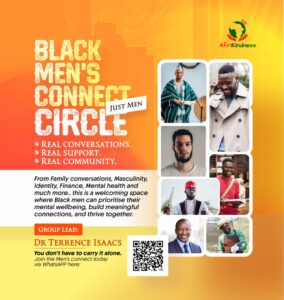
Men – Register here to join the Men’s Circle:– https://forms.gle/u6HVHkVvfd6dNSsZ9
There is an upcoming Men’s event in October. Find out more and register here:- https://BlackMenConnectCircle.eventbrite.co.uk
Work With Us
Afrikindness welcomes opportunities to work with organisations that want to strengthen the way they engage and support culturally diverse communities.
For NHS, statutory and voluntary-sector organisations
We can support community engagement, co-production, focus groups, research participation, culturally responsive consultation and training, helping organisations listen to communities and incorporate lived experience into service development.
For professionals and service providers
Our work can support teams seeking to strengthen culturally inclusive and responsive practice, particularly around mental health, family engagement, safeguarding, neurodiversity and working effectively with African and ethnically diverse communities.
For community and faith leaders
We can bring community mental health awareness sessions and conversations directly into trusted community spaces, helping people understand mental health, challenge stigma, recognise when someone may need support and become more confident about accessing appropriate services.
For researchers and universities
Afrikindness can support community-led and co-produced research, particularly where meaningful engagement with Black African and other underrepresented communities is essential.
Interested in working with us?
Explore Afrikindness’ mental health programmes, community services and research, or contact our team to discuss training, co-production, community engagement or partnership opportunities.
Find out more here:- https://afrikindness.org/mentalhealth/
Partnership enquiries: partnerships@afrikindness.org
The conversation continues
We extend our sincere thanks to everyone who participated in the research, particularly the community members who trusted us with their experiences.
We also thank Leeds Mental Wellbeing Service, Touchstone, Dr Terrence Isaacs, Beth Stephan, Bunmi Owolabi and the professionals, community leaders and organisations who contributed to the research and dissemination conversation.
The challenge now is to ensure that community voices do not simply become words within a report.
We listened. We learned. Now we must act.
Because moving from mental health inequalities towards better access will require communities and services to continue listening to one another — and building solutions together.